


Trading options profitably is more than just hitting the buy or sell button if I think the price of a stock is going to move in a certain direction. There are several layers that determine how option prices move relative to the underlying asset. Without understanding this, it can mean seeing the underlying asset price move in the expected direction, but the options price does something unexpected, such as not moving at all or moving in the opposite direction of what was expected. I’ve seen this happen to traders in real trades: they expect the price of a stock to go up, so they buy a call option, but even when the stock price increases, the option price goes down due to time decay or implied volatility.
Top Regulated Brokers
To prevent situations like this means knowing how the options metrics named “The Greeks” work. (They are called “The Greeks” because they are named after the letters in the Greek alphabet.) I learned about the Greeks a few years into my options trading, but I wish I had learned it right at the beginning.
There are four main options Greeks that I will cover in this article, in order of what I consider to be their importance:
Delta - change in underlying asset price on the option price
Theta - the rate of time decay
Vega֫ - change in the options price when implied volatility changes
Gamma - change in Delta when the underlying asset price changes
I will also cover a minor Greek, Rho, that measures the change in the options price when interest rates change.
Note: Options are available across many markets, including stocks, indexes, and commodities. Because of the popularity of stock options, I will often refer to the underlying assets as stocks in this article, but the same principles will apply to all types of options.
Options Basics
The focus of this article will be on the Greeks, but I will first briefly cover some basics of how options work. If you already understand terms such as calls, puts, in-the-money and out-of-the-money, feel free to skip this section. If these terms are new to you, I recommend doing more research on the basics of options to help your understanding.
Call Options
A call option is the right to buy an underlying asset, such as 100 shares of a company, at a specified price (known as the strike price) by a specified date (known as the expiration date). I would have to pay a cost to buy a call option, which is known as the “premium.” If I wished to go short a call option, e.g., give someone else the right to buy 100 shares from me at a specified price, I would receive the premium.
E.g., an Apple call option with a strike price of $250 and an expiration date of August 30 gives the holder of the call option the right to buy 100 Apple shares at $250 on August 30.
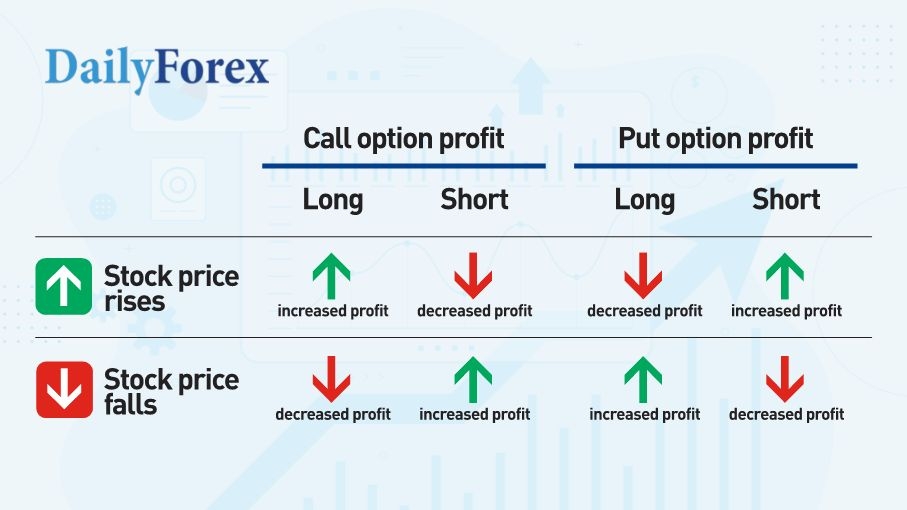
The value of call options usually moves in the same direction as the underlying asset:
If the price of the underlying asset rises, the value of a call option usually rises.
If the underlying asset's value falls, the value of the call option usually declines.
I say “usually” because there are other factors that can work in the opposite direction, such as time value and implied volatility.
Put Options
A put option is the opposite of a call option: it is the right to sell an underlying asset at a specified price (the strike price) by a specified date (the expiration date). I would have to pay a cost to buy a put option, which is known as the “premium.” If I wished to go short a put option, e.g., give someone else the right to sell 100 shares to me at a specified price, I would receive the premium.
E.g., an Apple put option with a strike price of $300 and an expiration date of August 30 gives the holder of the put option the right to sell 100 Apple shares at $300 on August 30.
The value of a put option usually moves in the opposite direction to the underlying asset:
If the price of the underlying asset rises, the value of a put option usually falls.
If the underlying asset's value falls, the value of the call option usually rises.
Just as with call options, I say “usually” because other factors can work in the opposite direction, such as time value and implied volatility.
In-The-Money (ITM), Out-Of-The-Money (OTM), and At-The-Money (ATM)
An option can be either in-the-money, out-of-the-money, or at-the-money. The difference between these is whether the strike price is above, below or near the current share price:
H4: In-The-Money Call Option
This is when the strike price is below the current share price.
For example, if a call option’s strike price is $100 and the share trades at $110, the option is in the money. (For in-the-money options, the difference between the strike price and the underlying asset price is known as the “intrinsic value.” The intrinsic value in this example is $10.)
H4: Out-Of-The-Money Call Option
This is when the strike price is above the current share price.
For example, if a call option’s strike price is $100 and the share trades at $90, the option is in the money. (Out-of-the-money options have zero intrinsic value.)
In-The-Money Put Option
This is when the strike price is above the current share price.
For example, if a call option’s strike price is $100 and the share trades at $90, the option is in the money. (The intrinsic value in this example is $10.)
Out-Of-The-Money Put Option
This is when the strike price is below the current share price.
For example, if a call option’s strike price is $100 and the share trades at $110, the option is out-of-the-money with no intrinsic value.
At-The-Money
The options contracts with the strike price closest to the current share price are known as at-the-money.
For example, if a share is trading at $101, the $100 put and call options would be at-the-money.
Intrinsic Value
Intrinsic value is the positive value (if any) if the option were to be exercised today, i.e., the difference between the strike price and the current share price. For example, if a share trades for $110, a call option with a $100 strike price has $10 of intrinsic value. That’s because the options holder has the right to buy the stock at $100 even though the market price is $110.
Time Value
Time value is the additional cost of the option contract above the intrinsic value. Let’s say an option contract trades at $50 and has $30 of intrinsic value-it therefore has $20 of time value.
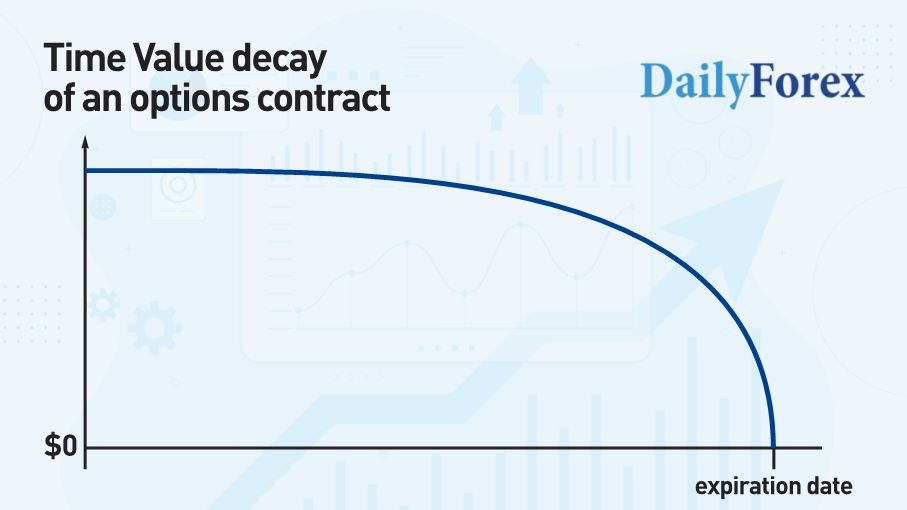
The time value “decays” and goes to zero at expiration. That means it costs money to hold an options contract. On the other side, an options seller collects the time value and keeps it when the option contract expires. (This is one of the main reasons investors sell options.)
One of the most important aspects of time value decay is that it’s not linear: it often decays much faster towards the end of the option’s life.
Summary of Options Basics
Before moving forward, ensure you are comfortable with the following concepts I have covered so far:
Call option vs put option
In-the-money vs. out-the-money vs. at-the-money
Intrinsic value
Time value
Now, let’s dive into the Greeks to understand how options’ prices move.
Delta (Δ)
Delta (Δ) measures the change in the option’s premium as a percentage of the change in the underlying share price. Or simply put, if a stock moves by X dollars, by how much should I expect the option’s price to move?
Writing this idea as a formula gives:
Delta (Δ) = Change in the price of an options contract / Change in the price of an underlying asset
The formula for Delta gives it a possible range of values between -1 and 1:
Long call options and short put options have a positive delta between 0 and +1
Long put options and short call options have a negative delta between 0 and -1
Think of Delta as a sensitivity meter. A Delta further away from zero (i.e., closer to -1 or +1) means it is much more sensitive to changes in the underlying asset price.
Let’s look at some examples.
Delta: 0 to 1
Let’s say a long call option has a Delta of 0.50. If the share price increases by $1, the option's value will increase by $50 ($0.50 x 100 shares). It means the trader’s P&L will move by 50% in the same direction as the share price.
Delta: 0 to -1
Let’s say a long put option has a Delta of -0.50. If the share price decreases by $1, the put option's value will increase by $30 ($0.30 x 100 shares). It means the trader’s P&L will move by 30% in the opposite direction of the share price.
Delta Will Change
The Delta of an options contract is not static. Delta is sensitive to changes in any of the following:
The time to maturity - this is guaranteed to change, because as time passes, the option gets closer to expiration
Underlying asset price
Implied volatility
I’ll look at this more closely when covering another options Greek, the “Gamma,” which measures the change in Delta when the share price moves.
Using Delta to Measure ITM Probability
Some traders use Delta as a gauge of the probability that an option will expire in the money. For example, if an options contract has a Delta of 0.7, it suggests the option has a 70% chance of being in the money at expiration.
I do not believe that Delta is a highly accurate predictor of whether an option will expire in the money, and I recommend caution when using it in this way until you have data showing it is a good predictor. In fact, some options brokers calculate ITM probabilities at expiration independently of the Delta.
Theta (Θ or θ)
Remember, time value decays, but the rate at which it decays changes over time (the decay usually speeds up as the option contract approaches its expiration date). The term “Theta” is a measure of the speed of time value decay for an options contract. It is stated as the daily expected decay in dollars.
For example, let’s assume:
Current share price: $50
Call option strike price: $50 (i.e., at-the-money)
Option premium (i.e., the cost of the option): $3. Because the option is at-the-money with no intrinsic value, the entire premium is time value.
Theta: 0.05
As long as nothing else changes, e.g., the share price does not move, or the implied volatility does not change, I would expect the time value to lose 5 cents per day. For this option, the premium tomorrow should be $2.95.
What else should I know about Theta? Here is what I consider most important:
Theta is initially gradual and then increases as it approaches expiration. That’s because the time value does not decay at a constant rate; it accelerates as an option contract approaches its expiration. In plain English, when an option is further away from expiration, the time value decay is generally less than when it is closer to expiration.
At-the-money options have the steepest drops in time value near expiration. In-the-money time decay tends to be more linear.
As a general rule of thumb for stock options in particular, Theta accelerates much more quickly when the options contract is within 30 days of expiration.
Theta is always negative for long positions because the holder of the option loses time value.
Theta is always positive for short option positions, because the seller keeps the premium as the option loses time value. That means Theta is generally good for sellers and bad for buyers.
Remember, Theta measures only the decay of the time value (extrinsic value), not the decay of the option's total value, which will contain intrinsic value if the option is in-the-money.
Changes in implied volatility affect Theta. For example, sometimes a day might pass without the time value dropping because implied volatility has increased. Or the time value may drop by more than the Theta predicted because implied volatility dropped.
Out-of-the-money with high implied volatility can have a high Theta.
A lot of option buyers simply lose money by not paying attention to Theta and buying options that are too close to expiration. They end up losing too much to time decay, even if they correctly predicted the direction of the underlying share price’s move.
Vega
Vega measures the change in an option’s premium for each 1% change in the implied volatility, and Vega is measured as a percentage. Think of Vegas as a measure of the option’s sensitivity to changes in implied volatility. Before going any further, let’s talk more about what implied volatility is.
What Is Implied Volatility?
In plain terms, implied volatility is what kind of move the market is expecting out of a stock. If the market is expecting a large move in a stock, its implied volatility will be higher. If the market expects a small move in a stock, its implied volatility will be less.
That means implied volatility tends to increase when there is uncertainty or when the market is anticipating news, e.g., when a stock’s earnings announcement is due. Conversely, implied volatility tends to decrease in calmer times.
Implied volatility is separate from past volatility; the two are not necessarily correlated. Some traders use the underlying asset’s historical volatility as a guide to implied volatility, but the market ultimately determines the current implied volatility.
One of the most important things I learned about implied volatility is that it can change even if the underlying stock price does not move.
Implied volatility is one of the biggest factors affecting an option's price, second only to changes in the underlying asset's value. For example, many investors lose money on long option positions when implied volatility goes down, because they’re chasing the momentum of a stock that ends up going nowhere. Implied volatility gets crushed, and so does their options premium.
What Is the Definition of Vega?
Vega measures the change in premium resulting from a 1% change in the implied volatility assumption. Longer-term options tend to have higher Vega than near-term options.
For example, let’s assume:
Current share price: $50
A call option has an implied volatility of 30% and a Vega of 0.15
The option premium (i.e., the cost of the option contract) is $4
If implied volatility instantly rises by 2 percentage points from 30% to 32%, I would expect the options premium to increase by 0.15 x 2 = $0.30, i.e., to $4.30.
Now, let’s say implied volatility instantly decreased by 5 percentage points from 30% to 25%. I would then expect the options premium to decrease by 0.15 x 5 = $0.75, i.e., to $3.25.
Longer-term options tend to have higher Vega than near-term options. That means longer-term options, i.e., where the expiration date is further away, and which are usually more expensive than shorter-term options, tend to change more in value when implied volatility changes.
Fun fact: Vega is, in fact, not a Greek letter; it is only a piece of options terminology that is bundled with the other Greeks.
Gamma (γ)
Understanding how Delta changes when the stock price changes means understanding Gamma. Gamma is the expected change in the option’s Delta when the share price changes by $1. To help make this clear, let’s look at an example.
Let’s say:
Current share price: $50
Call option strike price: $50 (i.e., at-the-money)
Option premium: $2
Delta: 0.50
Gamma: 0.7
Using this data, if the share price moves up $1 from $50 to $51, I would expect the option premium to rise by $0.50 (because of its 0.50 Delta) from $2.00 to $2.50. With the Gamma of 0.05, I would then expect the new Delta for the option at the $51 share price to be 0.62 (simply adding the 0.07 Gamma to the old 0.50 Delta).
What if in the same example, the stock price went down by $1 from $50 to $49? Then the new Delta would be less positive by the Gamma amount, i.e., the new Delta for the option would be 0.43 (0.50 minus 0.07).
How Does Implied Volatility Affect Gamma?
Implied volatility has an inverse relationship with Gamma: low implied volatility results in higher Gamma, while high implied volatility results in lower Gamma.
As implied volatility decreases, the Gamma of at-the-money options moves further away from zero. This is because options with low implied volatility will have a larger change in Delta when the underlying moves.
When implied volatility increases, the Gamma of both in-the-money and out-of-the-money calls and puts decreases. This is because when implied volatility is high, the underlying asset will see less Delta change with movement, as the possibility of greater movement is already factored in by the high implied volatility.
What Else Should I Know About Gamma?
Here is what I consider most important:
Gamma is higher for options that are at-the-money compared to deep in-the-money or deep out-of-the-money options.
Gamma is higher for options closer to expiration, especially when the option is at-the-money. For example, an at-the-money option expiring within a month will have a higher Gamma than an option with the same strike price expiring in a year. That’s because the near-term option’s Delta will have an imminent move towards 0 or +1/-1 right near expiration.
Gamma is typically highest when the Delta is in the 0.40–0.60 range (which is typically where the Delta for at-the-money options sit).
As Deltas approach 0, or +1 for calls and -1 for puts, Gamma is usually at its lowest point.
Given that Gamma is higher for at-the-money options and for those close to expiration, I would expect an at-the-money option expiring next week to have a much higher Gamma than an in-the-money option expiring next year.
Long options (calls and puts) always have positive Gamma.
Short options (calls and puts) will have negative Gamma.
For long calls, as the stock price rises, the option’s Delta will become more positive and move towards +1.00, i.e., the option has a positive Gamma. That also means the Delta for long calls gets closer to zero as the stock price falls.
For long puts, as the stock price falls, the option’s Delta will move towards -1.00, and get closer to zero when the stock price rises.
Rho
Rho measures the change in an option’s premium for a 1% change in interest rates.
Rho is positive for long call as higher interest rates increase call premiums.
Rho is negative for long puts as higher interest rates decrease put premiums.
The reason interest rates affect option premiums is that pricing models reflect the cost of capital used to hedge the risk market makers take in these positions.
Let’s look at an example to see how it works:
Current interest rate: 3.00%
Rho on a call option: +0.45
Rho on a put option: -0.45
If interest rates suddenly jump to 4.00%, I would expect the call option premium to rise by $0.45 per share, and the put option premium to fall by $0.45 per share.
Key Takeaways
Trading options is not as simple as buying cheap calls or puts and waiting for the options price to move in my favour. There are other factors that move option prices, and these factors, as measured by the Greeks, are critical to profitable options trading. Here are my key takeaways:
Picking the correct options contract can make you much more profitable, even if you are not 100% correct on the price move of the underlying asset.
Picking the wrong options contract can lose you money even if the underlying asset moves in the direction you expected.
Focus on Delta, Theta, and Vega.
Many option traders try to time the move of a stock or other asset too accurately, and buy options with too little time to expiration, and end up losing money on time decay. Understanding Theta will help you avoid this.
Many option traders overpay for options on long positions because they buy high implied volatility. If the implied volatility goes down, so will the value of your options contract, even if the underlying asset price does not move against you.