


Data provided by TradingView shows that BTC ranged from a high of $74,000 on Tuesday, March 17, to a low of $67,400 on Monday, before returning to its current price of $70,790 – which is right around the midline of the range it's been in since early March.
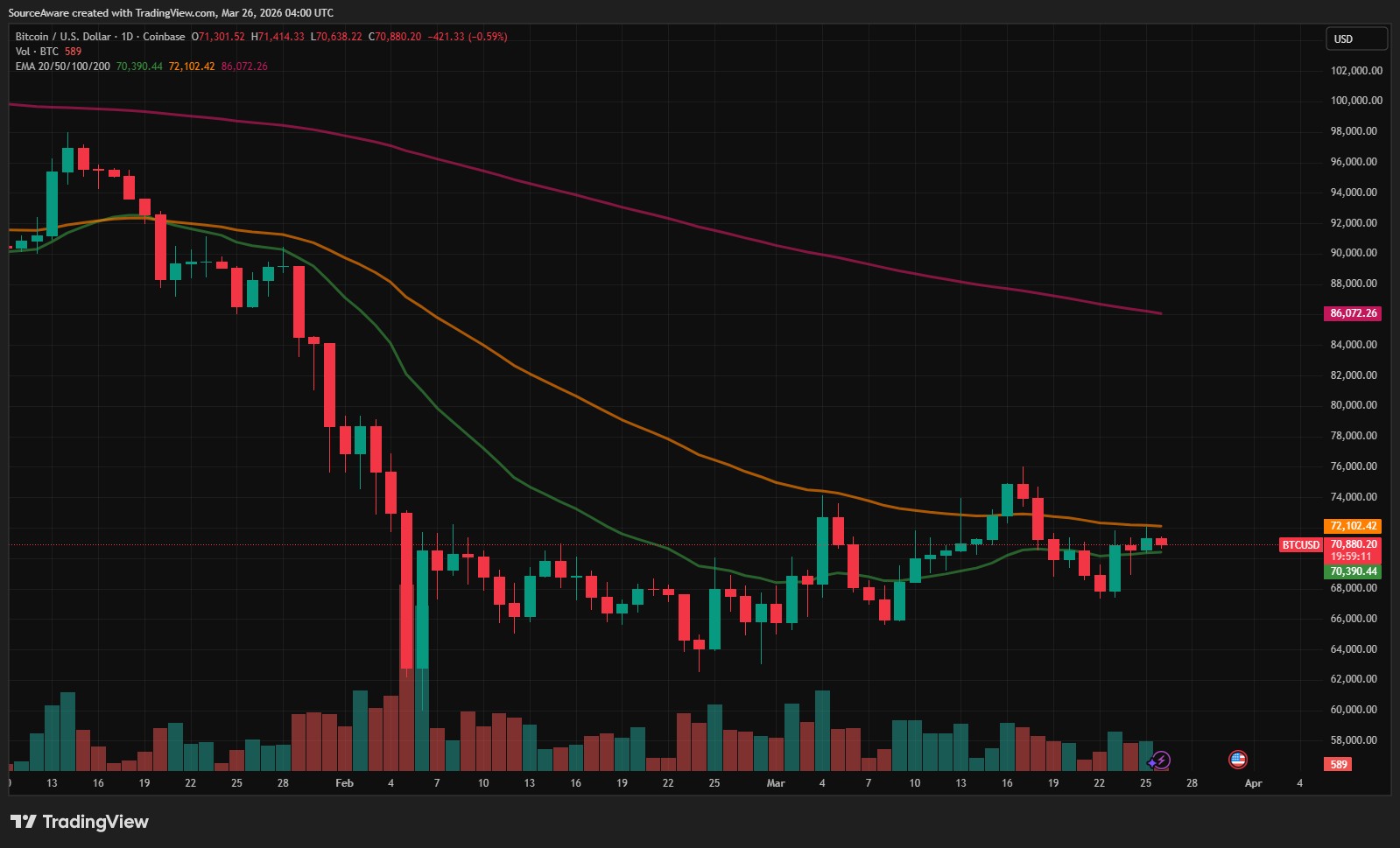
BTC/USD 1-day chart. Source: TradingView
Along with its price averaging around $70,500 – providing some wealth protection in uncertain times – daily trading volumes remained elevated, exceeding $30–$50 billion on peak days, signaling sustained investor engagement even as the market digested external shocks.
Several factors drove this movement. Geopolitical tensions in the Middle East, particularly U.S.–Iran dynamics, initially weighed on risk assets. However, reports of the Trump administration postponing potential strikes on Iranian infrastructure helped ease concerns, lifting oil prices lower and supporting a modest BTC recovery.
Macroeconomic signals also played a role. The Federal Reserve's decision to hold interest rates steady contributed to choppy sentiment, while a massive $14–$17 billion Bitcoin options expiry loomed for Friday, creating potential for amplified swings around key strike levels.
On the bullish side, Bitcoin ETFs attracted over $2.5 billion in March inflows, highlighting robust institutional demand and contrasting with outflows from traditional safe\ -havens like gold. Market sentiment shifted from "extreme fear" toward neutral territory, with open interest rising and large transactions declining slightly. This indicates consolidation rather than capitulation, and Bitcoin’s refusal to break below $68,000 underscored its underlying strength as a hedge against uncertainty.
At the time of writing, BTC trades at $70,880, a decline of 0.5% on the 7-day chart.
Historic Regulatory Announcements Lifts Spirts (Not Prices)
While the price action across the crypto market reflected short-term noise, last week's biggest catalyst arrived on March 17 with landmark joint guidance from the Securities and Exchange Commission (SEC) and Commodity Futures Trading Commission (CFTC).
In a 68-page interpretive release titled "Application of the Federal Securities Laws to Certain Types of Crypto Assets and Certain Transactions Involving Crypto Assets," the agencies delivered long-sought regulatory clarity. For the first time, they explicitly classified most major cryptocurrencies as "digital commodities" rather than securities, providing binding guidance that supersedes prior staff statements and carries full commission weight.
The statement provides a clear taxonomy dividing crypto assets into categories: digital commodities (driven by network functionality and supply-demand dynamics), digital collectibles, digital tools, stablecoins, and digital securities.
A total of 16 tokens were specifically identified as digital commodities, including Bitcoin (BTC), Ether (ETH), Solana (SOL), XRP, Cardano (ADA), Avalanche (AVAX), Chainlink (LINK), Dogecoin (DOGE), Polkadot (DOT), Litecoin (LTC), Shiba Inu (SHIB), Stellar (XLM), Tezos (XTZ), Hedera (HBAR), Aptos (APT), and Algorand (ALGO).
The agencies noted that these assets get value primarily from programmatic utility rather than the "efforts of others," placing them largely under CFTC oversight via the Commodity Exchange Act while remaining outside SEC securities jurisdiction in most cases.
Additionally, the guidance addresses several common activities that had, up to this point, been major gray areas. This includes proof-of-work mining on public networks and proof-of-stake staking are not considered securities offerings under the Howey test when conducted in decentralized contexts.
Overall, the guidance removes lingering enforcement risks and provides "fair notice" to builders and investors. CFTC leadership joined the release, affirming consistent administration of commodities laws and emphasizing coordination through their new Memorandum of Understanding and Joint Harmonization Initiative.
The response from the crypto industry and community has been overwhelmingly positive.
<blockquote class="twitter-tweet"><p lang="en" dir="ltr">?? US sets the tone for crypto’s next phase.<br><br>CFTC Chair: “Crypto will power the new frontier of finance” with real regulatory clarity and no overreach on permissionless systems.<br><br>SEC + CFTC alignment is coming.<br><br>Institutional capital is next.LFG! <a href="https://t.co/XEDdkJ33bK">pic.twitter.com/XEDdkJ33bK</a></p>— Xaif Crypto??|?? (@Xaif_Crypto) <a href="https://twitter.com/Xaif_Crypto/status/2035045187282772450?ref_src=twsrc%5Etfw">March 20, 2026</a></blockquote> <script async src="https://platform.twitter.com/widgets.js" charset="utf-8"></script>
My Take
For years, regulatory ambiguity stifled innovation and drove capital overseas. This framework, which comes positioned alongside ongoing congressional efforts for market structure legislation, signals a pro-innovation shift under the current administration.
Crypto adherents have long maintained that most crypto assets are not securities, and this release clearly acknowledges that fact. While digital securities (e.g., tokenized stocks) remain under SEC purview, the bulk of the ecosystem gains breathing room.
Together, Bitcoin's steady price action and this regulatory breakthrough paint an optimistic picture. Short-term volatility from geopolitics and expiries may persist, but the clarity removes a major overhang, potentially fueling sustained institutional inflows and mainstream adoption. As the market digests these developments, Bitcoin's role as digital gold appears more secure than ever.
We hope you enjoyed reading our analysis of what’s going on with crypto regulation. If you’d like to trade with one of the best crypto CFD brokers, check out our list.