


Despite an uptick in aggression and increased uncertainty around the conflict in the Middle East, Bitcoin broke out to territory not seen since January, peaking near $82,000 on Tuesday amid green shoots across the altcoin market.
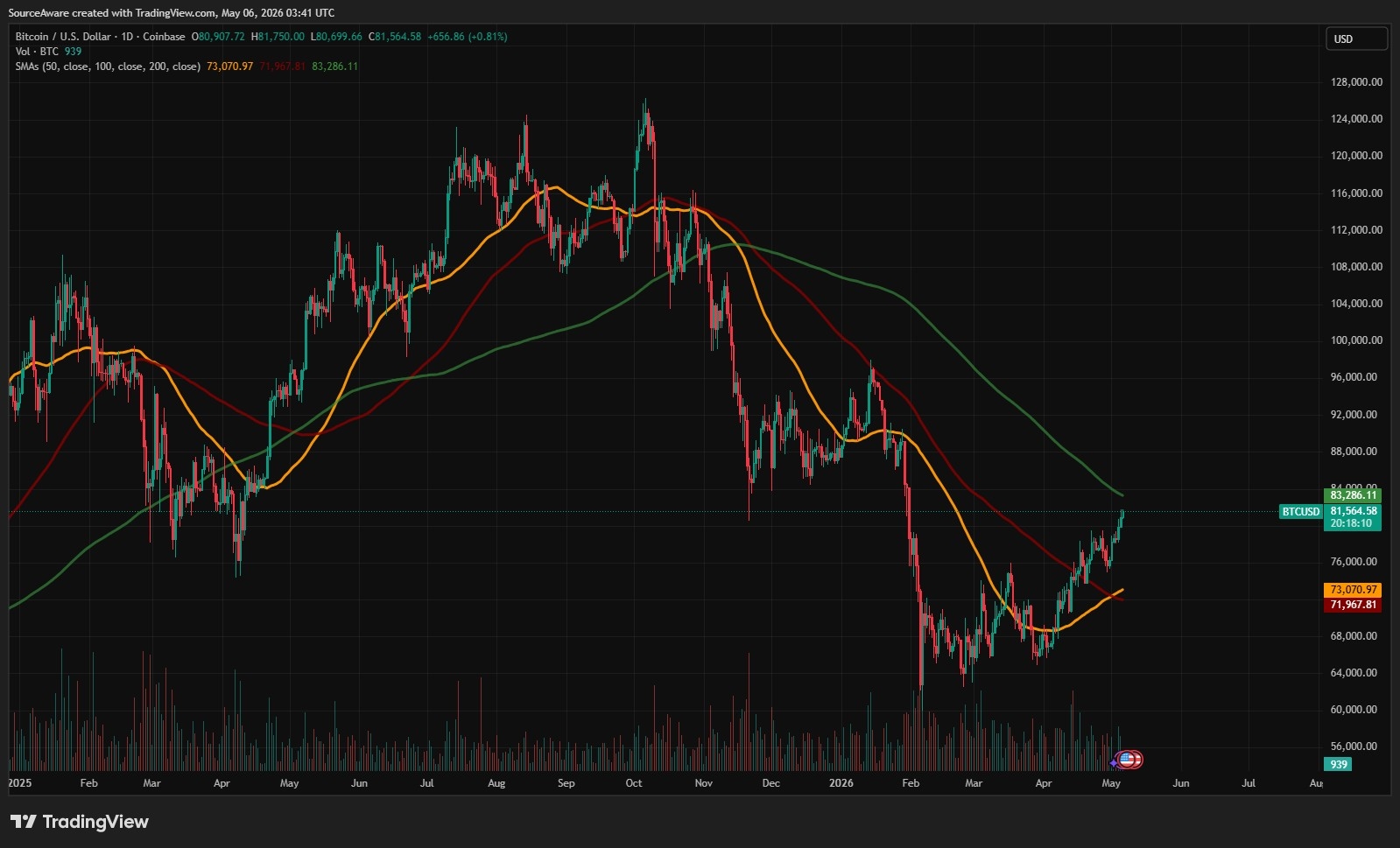
BTC/USD 1-day chart. Source: TradingView
The sudden upswing has stoked enthusiasm from bulls, who see BTC’s turnaround from $75,000 last Wednesday to resistance at $82,000 in less than a week as a promising sign of things to come. Technical analysts noted the move validated a recovery from February’s lows near $60,000, with the price now hovering between key Fibonacci levels: $79,000 as support and $83,500 as resistance.
Among the most positive signs was the spike in volume, which reflects renewed institutional and retail conviction, meaning everyone is joining the party.
The tailwind seen across financial markets has in part been attributed to U.S. President Donald Trump’s “Project Freedom” operation, a U.S. military operation to escort commercial vessels through the Strait of Hormuz following Iran's peace proposal. The announcement helped ease global risk sentiment, with crude futures down nearly 5% in the aftermath, while Bitcoin and other risk assets enjoyed a rising tide.
At the time of writing, Bitcoin trades at $81,564, an increase of 5.9% on the 7-day chart.
Major Behind the Scenes Developments
Beyond the macro happenings, there were several crypto-specific advancements that triggered positivity and proved the asset class has reached a new level of legitimacy. Bitcoin’s price action is no longer isolated; it is reacting to a structural shift in how finance itself is being rebuilt.
The timing of the rally coincides precisely with groundbreaking regulatory and infrastructure developments that unfolded just two weeks earlier. The significance of what unfolded in late April cannot be overstated.
In just one tightly sequenced spurt from April 21 to 23, three interlocking moves created the legal, banking, and political scaffolding for tokenized assets and stablecoins to integrate directly into the heart of global finance.
To the untrained eye, this implementation got lost in the noise as a coincidence. But for those in the know this has all the hallmarks of a coordinated launch.
On April 21, SEC Chairman Paul Atkins announced the “Innovation Exemption” at the Economic Club of Washington. Simply stated, the SEC greenlit tokenized stocks, including apple, Tesla, Nvidia, and others, to trade directly on decentralized protocols.
This is a gamechanger compared to the current system. No broker, no clearinghouse, no three-day settlement. Transactions settle on-chain within seconds. The 233-year-old monopoly of the New York Stock Exchange now faces a 12-to-36-month expiration date.
The very next day, April 22, a company called Infinite launched business bank accounts that seamlessly combine fiat and stablecoin payments through a single API. Erebor Bank – which is FDIC-insured, founded by Palmer Luckey of Anduril, and backed by Peter Thiel’s Founders Fund – is the underlying bank. It has now become the first American bank purpose-built to hold stablecoins on its balance sheet for AI companies, defense contractors, and crypto-native businesses.
We’ve just seen the rollout of the on ramp for stablecoin treasury management at scale.
Then, on April 23, 120 crypto leaders, including Coinbase, Ripple, Kraken, Circle, Solana, and major policy groups, signed a unified letter demanding the Senate Banking Committee schedule a markup on the Clarity Act. They stood in unison to declare a message: the industry is aligned and pressing for final regulatory clarity.
Combined, these events formed a single orchestrated rollout: legal doors opened (SEC), banking plumbing installed (Erebor/Infinite), and political pressure applied (Clarity Act). We’ve been hearing about the merge of TradFi and DeFi for years, and with this, the infrastructure for crypto to absorb and surpass Wall Street is no longer coming; it has arrived.
My Take
But what does this mean at the macro level? Simply put, big changes.
Traditional capital markets are being disintermediated. Tokenized equities and real-time on-chain settlement will lead to droughts in the economic moats of brokers, custodians, and exchanges. Stablecoin-native banking will allow corporations and governments to operate with programmable money, 24/7 liquidity, and minimal counterparty risk.
The old guard that controlled SWIFT and other financial rails is seeing its power now shift toward those who control the new rails: blockchain protocols, stablecoin issuers, and decentralized infrastructure providers.
Over the next decade, this fusion of crypto rails with traditional assets could unlock trillions in efficiency gains, expand access to capital markets, and integrate finance with AI and defense sectors in ways previously unimaginable. Bitcoin’s surge past $80,000 is not merely a price event; it is the market pricing in the realization that the old financial system’s expiration clock has started. The people and protocols that own the new rails will shape the next era of global finance. The window to participate is now.
We hope you enjoyed reading our analysis of what’s going behind the scenes with crypto and Bitcoin. If you’d like to trade with one of the best crypto brokers, check out our list.