


Bearish view
Top Regulated Brokers
Sell the EUR/USD pair and set a take-profit at 1.1250.
Add a stop-loss at 1.1425.
Timeline: 1-2 days.
Bullish view
Buy the EUR/USD pair and set a take-profit at 1.1425.
Add a stop-loss at 1.1250.
The EUR/USD pair continued its downward trend, reaching its lowest level since May last year after the US published mixed macro data. It dropped to 1.1325 on Thursday morning, down 3.18% from its highest point in August, with focus shifting to the upcoming nonfarm payrolls report.
US Nonfarm Payrolls Data
The EUR/USD pair retreated after the US published mixed macro data. A report by ADP showed that the private sector added 90k jobs in September after adding 36k last month. The increase was better than the sector median of 73k.
This report suggested that the US economy is doing relatively well. Focus now shifts to the upcoming US nonfarm payrolls (NFP) report, which is expected to show that the economy continued adding thousands of jobs. A strong jobs report will raise the possibility that the Fed will hike interest rates again this year.
Another report showed that inflation rose at a faster rate than expected in August. The core Personal Consumption Expenditures (PCE) rose from 0.1% in July to 0.2% in August, lower than the expected 0.3%. This figure rose by 3.0%, also lower than the expected 3.3%.
The same was true with the headline PCE report, which rose from 0.1% in July to 0.3%, lower than the expected 0.4%. Another report showed that the economy expanded by 2.2% in the second quarter, higher than the previous estimate of 2.1%.
These numbers pushed bond yields higher. The 10-year rose to 5.28%, while the five-year rose to 5.07%. In addition to tomorrow’s nonfarm payrolls (NFP) data, the EUR/USD pair will react to the upcoming US and European manufacturing and services PMI numbers. Several Fed officials, like Susan Collins, Jeff Schmid, and Christopher Waller, will talk.
EUR/USD Technical Analysis
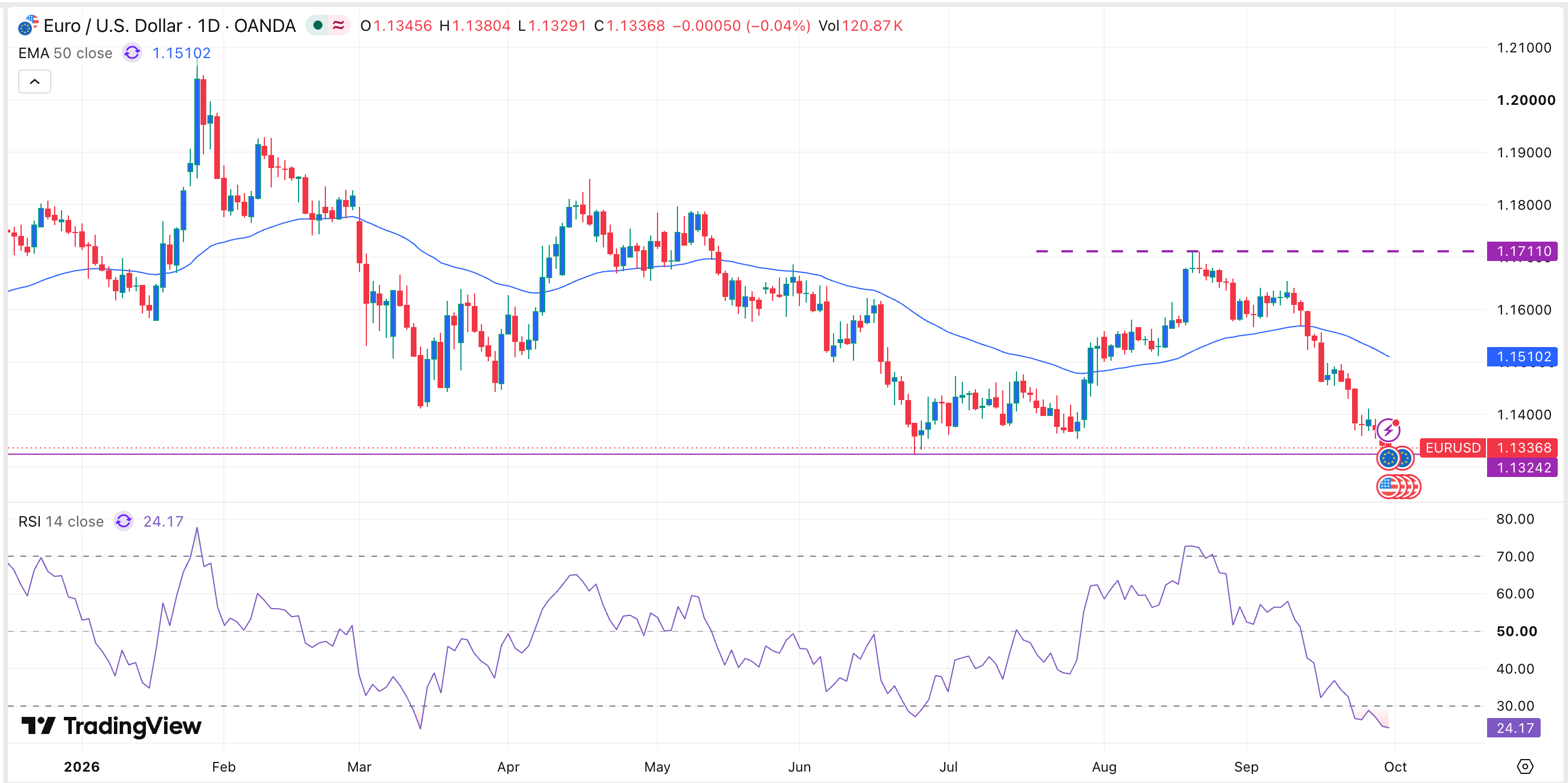
The daily chart shows that EUR/USD has been in a strong downtrend since August, slumping from a high of 1.1711 on August 21 to the current 1.1337. This is an important level because it coincides with the June low.
The pair has slumped below the 50-day moving average and is trading along the lower band of the Bollinger Bands. On the positive side, the Relative Strength Index (RSI) has dropped to 24, its lowest level since March.
Therefore, the pair may continue falling as bears target the key support of 1.1200. On the other hand, there is a possibility that the pair will bounce back, potentially to 1.1400.