


Oracle (NYSE:ORCL) just watched its credit rating slip to one notch above junk status, and options traders have responded with a moderately bearish tilt even as the stock hovers near 52-week lows, deepening existing concerns. Is the options market simply catching up to what the balance sheet has been signalling for months?
While some retail traders may consider the current share price a buying opportunity, what does the disconnect with options traders highlight about underlying risk appetite?
What Bearish Options Flow Reveals About Oracle’s Debt Risk
Options flow on Oracle has skewed bearish in recent sessions, with put dollar volume outweighing call volume and implied volatility at its highest level in the past year. Shares fell again last week, and traders have been positioning for continued turbulence rather than a snapback. It extends an ongoing trend, as outlined in last week’s note, “Oracle’s Debt: Does the Cloud Story Mask a Widening Cash Flow Problem?”
Oracle remains in the headlines for its debt-driven AI strategy and concentration risk, but options traders are at odds with equity analysts. When implied volatility rises alongside a credit downgrade, is that a coincidence, or is the options market pricing in genuine default-adjacent risk that equity analysts have been slower to acknowledge?
Top Regulated Brokers
Key Oracle Fundamentals and Technical Signals Behind the Downgrade
S&P Global cut Oracle’s long-term issuer rating from BBB to BBB- on July 10th, due to rising business risk and weakening cash flow amid heavy AI investment. It now projects Oracle’s fiscal 2027 free cash flow deficit could widen to roughly $42 billion, nearly double its prior estimate. Does a business burning cash at this rate deserve the benefit of the doubt simply because its AI backlog keeps growing and headline demand remains strong?
Metric | Value | Verdict |
P/E Ratio | 24.08 | Bullish |
P/B Ratio | 10.79 | Bearish |
PEG Ratio | 0.79 | Bullish |
Current Ratio | 1.12 | Bearish |
Return on Assets | 6.50% | Bearish |
Return on Equity | 53.38% | Bullish |
Profit Margin | 25.37% | Bullish |
ROIC-WACC Ratio | Negative | Bearish |
Dividend Yield | 1.39% | Bearish |
Oracle Fundamental Analysis Snapshot
Price action remains in a bearish price channel, and bearish trading volumes have risen after the downgrade of Oracle’s debt. The Bull Bear Power Indicator turned bearish, and the descending trendline could keep short-term gains limited.
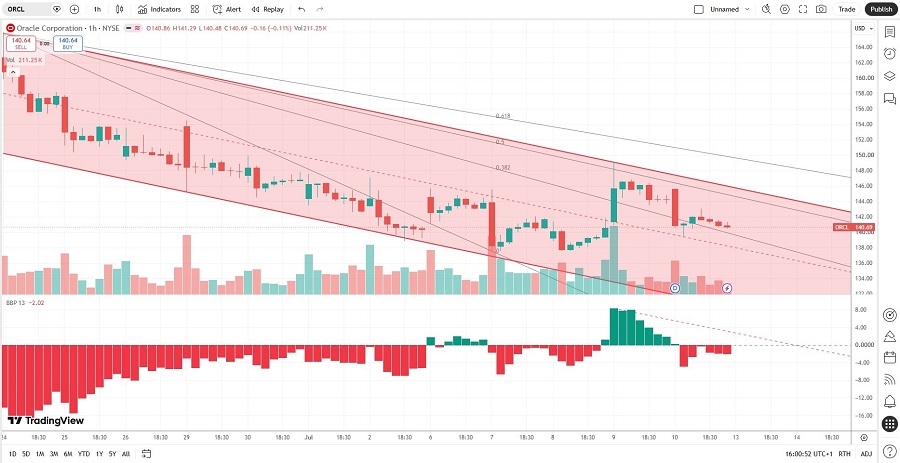
Oracle Price Chart
The Underappreciated Risks Behind Oracle’s Debt‑Heavy AI Financing Strategy
Oracle added shareholder dilution to its debt binge to protect what remains of its investment-grade rating. It announced plans to issue $20 billion in equity following a $5 billion preferred stock sale in February. This dilution, layered atop already-elevated leverage, is what options traders tend to punish first and ask questions later. With OpenAI accounting for roughly half of Oracle’s performance obligations, how much of this debt-funded buildout depends on the assumption that a single customer’s AI ambitions play out exactly as planned?
S&P warned that a further downgrade would push Oracle to BB+, below investment grade for the first time in its history. Therefore, every incremental debt raise and equity issuance might keep options traders leaning toward caution rather than conviction.
What Options Traders Reveal About Sentiment Toward Oracle’s Debt Story
Despite ongoing debt-centered issues and a high-risk AI strategy, the average analyst price target of $251.85 reflects excellent upside potential, creating a disconnect that reflects the skepticism building in the options pits. Are analysts still anchored to backlog headlines while options traders quietly reprice the debt risk sitting beneath them?
The moderately bearish options tone suggests that some traders believe the balance sheet story has not yet been fully reflected in the share price. Should equity traders consider the bond story more heavily?
What’s Next for Oracle’s Debt‑Driven Setup and Price Action?
Price action is currently descending between 38.2% and 50.0% Fibonacci Retracement Fan levels, with bearish trading volume rising steadily. Does Oracle have a credible near-term path to positive free cash flow, or is the options market right to keep betting against it? The $137.54 level could provide more directional clarity for bears, but what if bulls retake $149.07 decisively?
Ready to trade our analysis of Oracle? Here is our list of the best stockbrokers worth checking out.